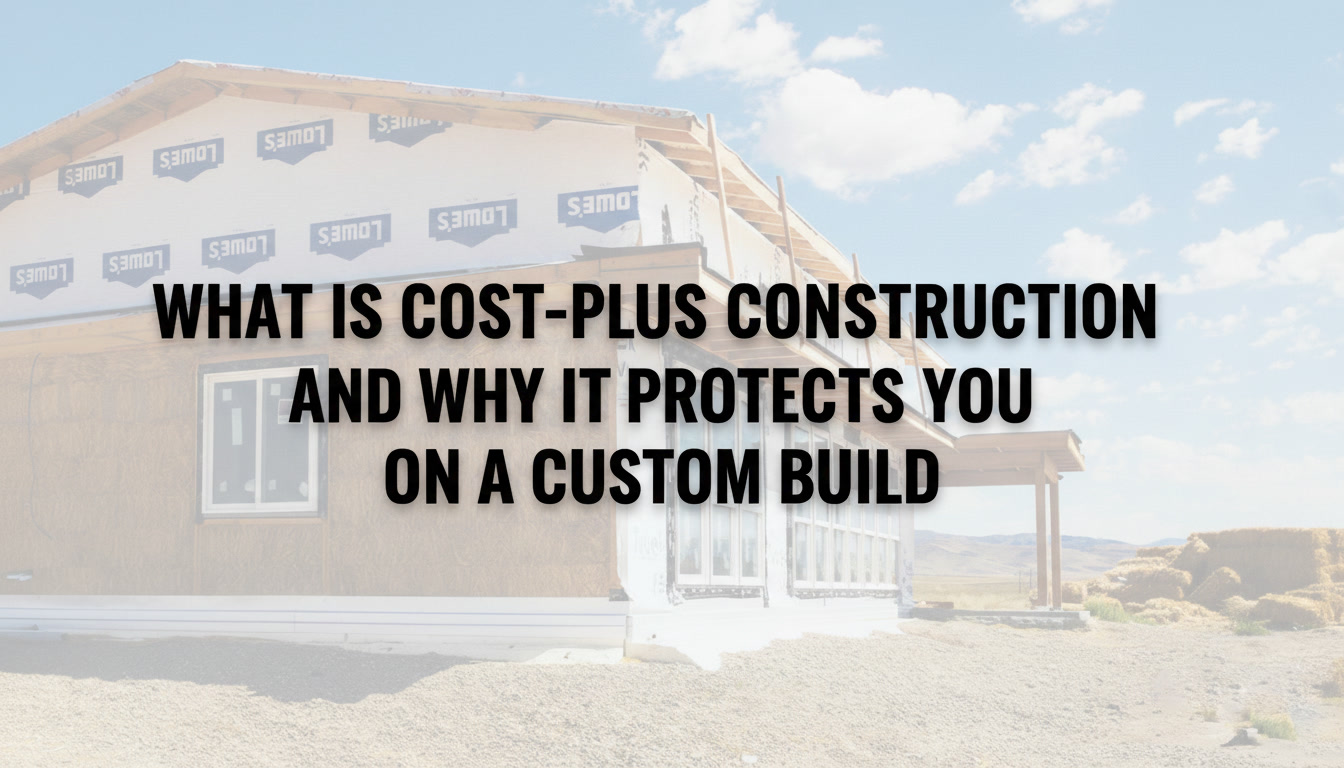
What Is Cost-Plus Construction and Why It Protects You on a Custom Build
What Is Cost-Plus Construction and Why It Protects You on a Custom Build
When you build a custom home, one of the most important decisions you make has nothing to do with design. It is how you and your builder handle money. There are two common models, fixed-price and cost-plus, and they create very different relationships between you and the person building your home. Understanding the difference protects you, so let me explain it plainly and tell you why we build the way we do.
A fixed-price contract works the way it sounds. The builder gives you one number for the whole project, and that is what you pay. It sounds safe, and for a simple, fully specified project it can be. But a custom home is rarely simple or fully specified at the start, and that is where the fixed-price model quietly works against you. To commit to a single number before every detail is decided, a builder has to pad that number to protect against everything that might go wrong. You pay for that cushion whether or not the risks ever materialize. Worse, once the price is locked, the builder’s incentive is to spend as little as possible getting to the finish, because every dollar saved is a dollar kept. When the homeowner wants quality and the builder is rewarded for cutting it, your interests are no longer aligned.
Cost-plus works differently. You pay the actual cost of the materials and labor that go into your home, plus an agreed-upon fee for the builder. Everything is transparent. You see what the lumber cost, what the windows cost, what the subcontractors charged. There is no hidden cushion, because there is nothing to hide. The builder’s fee is set, so we do not make more by spending more, and we do not make more by cutting corners. We make our fee for managing your project well. That single change realigns everything. When you choose better materials, that is your decision and your money, and we have no reason to talk you out of it. When we find a way to save you money, that saving goes to you, not into our margin.
The objection people raise is the obvious one. If there is no fixed number, how do I control the budget? This is the part that matters, and it is where trust and experience do the work. Cost-plus is not a blank check. A good cost-plus project starts with a detailed, realistic estimate and a clear budget that we build and manage to. You see the numbers as the project moves, not at the end as a surprise. You make decisions with real information in front of you. The difference is that you are managing the actual cost of your actual home, with full visibility, rather than paying a padded number and hoping the builder is not cutting quality where you cannot see it.
This is also why the model only works with the right builder. Cost-plus requires honesty, because the entire arrangement is built on you being able to trust that the costs you are shown are real and that the project is being managed in your interest. That is not a problem for us. It is the point. We would rather earn your trust through transparency than ask you to take a single padded number on faith. Ron built this company on doing right by people, and there is no version of cost-plus integrity that survives if the numbers are not honest. The model and the values have to match.
There is a deeper reason cost-plus fits the kind of homes we build. A high-performance straw bale home is full of decisions that affect long-term value, not just upfront cost. The wall system, the windows, the passive solar details, the systems that determine whether your home runs on next to nothing or fights the climate for the next thirty years. Under a fixed-price model with a builder rewarded for cutting, every one of those decisions is a place to quietly downgrade. Under cost-plus, we can have an honest conversation about where your dollars do the most good over the life of the home. You are not buying the cheapest version of a custom home. You are investing in the right version, with a builder who has no financial reason to steer you wrong.
This connects directly to how we think about cost in the first place. We do not believe the cheapest home is the smart home, and we do not measure a project by its lowest possible number. We measure it by what it costs to own and enjoy over decades, by how it performs, and by whether it serves your family the way you intended. Cost-plus is the contract model that matches that philosophy. It keeps the focus on value rather than on shaving a number, and it keeps you and your builder on the same side of the table.
When you are about to invest in a home you will live in for generations, the model that protects you is the one built on transparency and aligned incentives. That is cost-plus, done with integrity, by a builder you can trust. If you want to understand exactly how that would work for your project, that is a conversation worth having before you commit to anyone.
