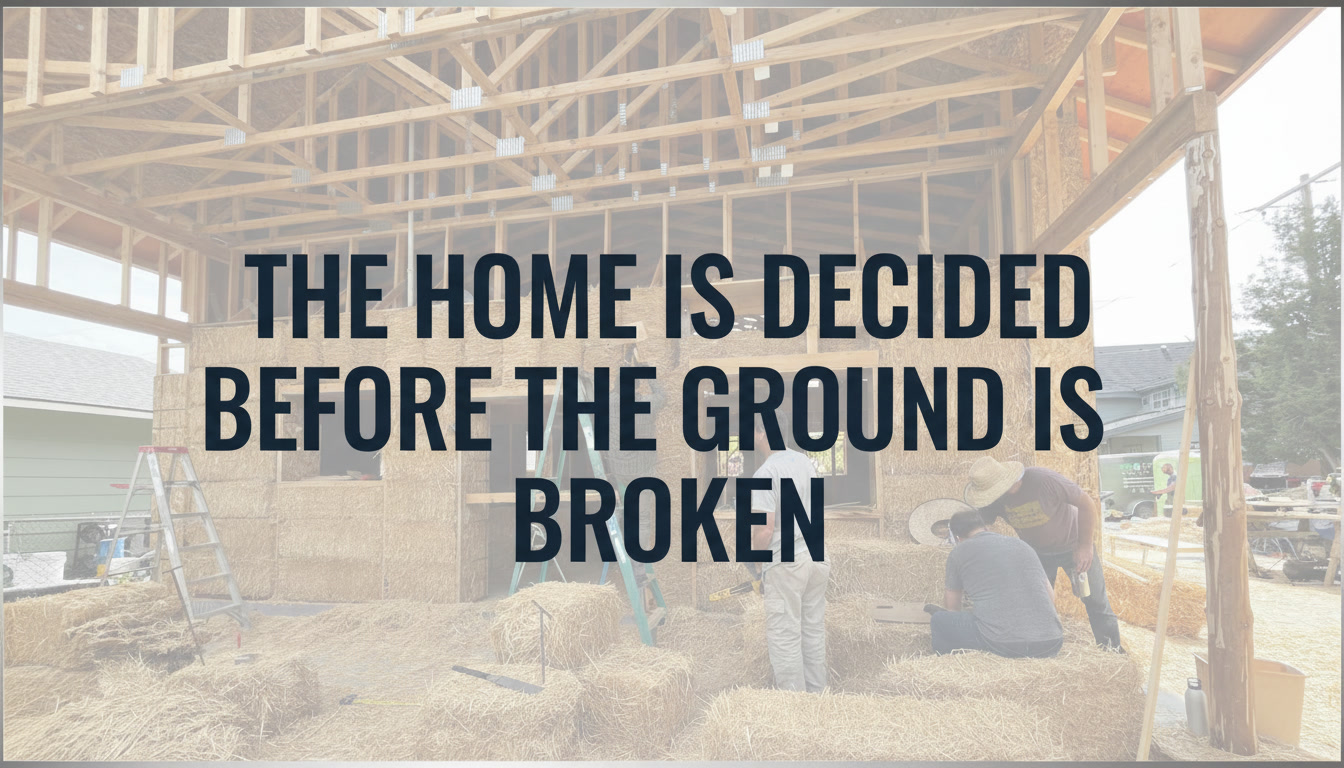
The Home Is Decided Before the Ground Is Broken
The Home Is Decided Before the Ground Is Broken
What Actually Happens When You Start a Custom Home?
People tend to picture the start of a custom home as a moment of action. Ground breaking, an excavator on raw land, the first visible sign that something is being built. That is a real and satisfying day. But it is not the beginning. By the time a machine touches the dirt, the most important work has already been done, and most people have no idea it exists.
The real start of a custom home is quiet. It happens across a table and on the land, in conversation, long before anything gets built. Understanding that first phase is one of the best ways to understand what you are actually signing up for when you build custom, and why it looks so different from buying a house someone else designed.
It starts with you, not a plan
A production builder starts with a plan. They have a set of designs, and the process is about fitting you into one of them. A true custom home starts the other way around. It starts with you, and the plan comes later, shaped around what we learn.
That means the first real work is discovery. How do you actually live? Where does your day begin, where does it settle in the evening, who is in the house and how do they move through it? What do you want more of in a home, and what has frustrated you in every place you have lived before? What does this home need to do for you not just now but for the decades you intend to be in it?
These are not small-talk questions. They are the foundation everything else gets built on. Before a single line is drawn, the goal is to understand the life the home is meant to hold. Get that right and every later decision has something true to refer back to. Skip it, and you end up with a house that looks nice and fits no one in particular.
Reading the land
Alongside understanding you, the other early work is understanding the land. Every piece of ground has its own character, and a custom home worth building responds to it rather than ignoring it.
Where does the sun track across the site through the seasons? That question alone shapes enormous parts of the design, because in a passive solar home the orientation determines how the house heats itself. Where are the views, and where is the weather? How does the land slope, where does water want to go, where is the natural place for the home to sit so it belongs on the site instead of being imposed on it? In the foothills, where does the home sit in relation to fire and defensible space?
Reading the land well is a craft. It is the difference between a home that fights its site and one that settles into it as if it had always been there. This is why we like to be involved before the land is even purchased when we can, because the right site read early prevents expensive discoveries later.
Where design and construction meet from the start
Here is what makes the design-build approach different, and it shows up right at this earliest phase. In the conventional model, an architect designs the home in one world and a contractor is brought in later to figure out how to build it. The design and the reality of construction meet late, and often they clash. Beautiful drawings turn out to be expensive or impractical to execute, and the homeowner is caught in the middle.
In design-build, those two worlds are joined from the first conversation. The people designing the home are connected to the people who will build it, so buildability, cost reality, and material knowledge are in the room while the design is still taking shape. When we consider a wall, we already know how it goes together. When we place a window, we understand what it means for the structure and the heating. Ideas get pressure-tested against reality as they form, not after they are locked in.
For you, that means fewer nasty surprises, a design that is grounded in what can actually be built, and a single team that owns the whole arc from this first meeting to the day you get the keys. There is no gap for things to fall into, no finger-pointing between separate parties. One group is responsible, start to finish.
A relationship, not a transaction
There is one more thing worth naming about how a custom home really starts. You are not just hiring a service. You are beginning a relationship that will last through the entire project, and the quality of that relationship shapes everything that follows.
Building a home is a long, personal, sometimes vulnerable process. You are making a place where your family will live and grow for years. That is meaningful work, and it deserves a builder who treats it as such, who listens, who tells you the truth, and who stays accountable to you the whole way through. The first phase is where that trust is established or not. Long before any commitment to construction, you should come away knowing whether these are people you want to walk this road with.
That is the real beginning. Not the excavator. The conversation. The understanding of your life and your land. The joining of design and construction into one accountable process. By the time the ground is actually broken, the home already exists clearly, in shared understanding and in plans that everyone believes in, and the build becomes the work of making real something that was thought through with care from the very first day.
So if you are standing at the edge of building custom, know that the start is not as dramatic as an excavator, and it is far more important. It is where the whole home is truly decided. Give that phase the time and honesty it deserves, and everything downstream of it goes better.
