Do You Need a Furnace High-Performance Idaho Home
Do You Still Need a Furnace in a High-Performance Idaho Home?
When most people plan a custom home, a furnace and a full duct system are simply assumed. It is on the list before anyone asks whether you need it. But in a true high-performance home, that assumption deserves a hard look, because the honest answer for many of our projects is that you need far less heating equipment than a conventional home, and sometimes almost none.
Here is why. A conventional home leaks heat constantly through thin walls, modest insulation, and air gaps, so it needs a large heating system running much of the winter just to keep up. A high-performance straw bale home does the opposite. R-45 walls, careful air sealing, and passive solar design mean the home holds onto the heat it gathers and barely loses any. When the home is not bleeding heat, it does not need a furnace fighting the cold around the clock. The wall does the work that the furnace would otherwise be doing.
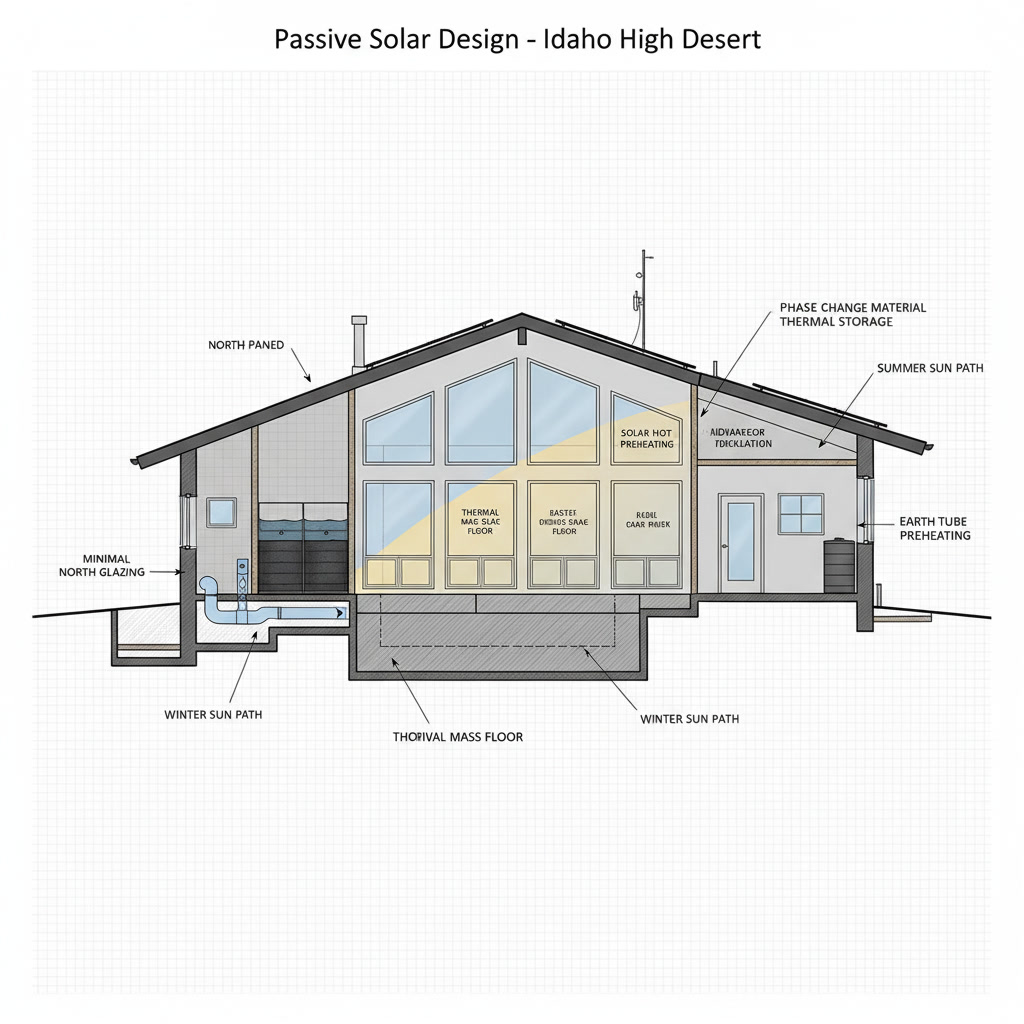
We have the documentation to back this up. Our Squaw Butte project ran zero mechanical heating from January through March of 2023. Three full months of Boise Valley winter, and the furnace never had to carry the home. The heat came from the sun through south-facing glass during the day, stored in the home’s thermal mass, and held inside by the wall system through the night. A single high-efficiency wood-burning stove handled the rest. That is not a laboratory result or a model on paper. That is a real home through a real Idaho winter.
So what does heating a high-performance home actually look like in practice? It usually comes down to a much smaller, simpler set of options than a conventional furnace and ductwork. A high-efficiency wood stove is a favorite in our climate, both for the heat and for the feel of it on a cold evening. A ductless mini-split heat pump is another excellent choice, sized far smaller than a conventional system because the load is so much lower, and it gives you efficient heating and cooling from the same quiet unit. Some homes use in-floor radiant heat for steady, even warmth. The right combination depends on the home and how you live, but the theme is consistent. You are choosing a modest, efficient heat source to supplement a home that mostly heats itself, not installing a large system to do all the work.
This changes more than your comfort. It changes the long-term math of owning the home. A smaller, simpler heating setup costs less to run, and there is less equipment to repair and eventually replace. A conventional home faces furnace replacement, compressor failures, and ductwork issues over the decades. A high-performance home with a modest heat source sidesteps much of that. Our straw bale homes run on a small fraction of the energy a conventional home of the same size needs to stay comfortable, and the heating system you do not have to oversize, run hard, and replace is part of that long-term value.
There is a design lesson underneath all of this. You cannot bolt high performance onto a conventional house at the end. The reason these homes need so little heating is that every decision, the orientation, the window placement, the wall system, the thermal mass, was made together, from the first conversation, to work as one system. A builder who designs and builds as one firm can make those decisions coherently. When design and construction are split between an architect and a contractor who never fully coordinate, the integration that makes minimal heating possible tends to fall through the cracks, and you end up back at a big furnace compensating for a home that was never tuned to its climate.
Now, an honest note. We are not promising every home runs with no furnace. Squaw Butte is what is possible when the site, the design, and the client’s goals all line up. Some homes will want a modest backup system for convenience, for resale comfort, or for the coldest stretches. The point is not that you will never have a heat source. The point is that in a properly built high-performance home, heating becomes a small, efficient, well-chosen detail instead of a large, expensive system you assume you cannot live without.
So do you still need a furnace in a high-performance Idaho home? Often, not the kind you are picturing. You need a home designed to hold its heat and a modest, efficient way to top it up. Build it that way and the furnace stops being the heart of the house and becomes, at most, a small helper to a home that does most of the work itself.
If you want to know what heating your specific home would actually require, that starts with looking at your land and your design together, where the real answer always lives.
