Passive Solar Design for Idaho's High Desert: Eliminate Heating Costs Entirely
Passive Solar Design for Idaho's High Desert: Eliminate Heating Costs Entirely
Idaho gets 200+ sunny days per year. The Boise Valley sits at 43.6 degrees north latitude, which means predictable solar angles and consistent winter sun penetration. This is passive solar territory. But most custom home builders in Idaho ignore it.
Passive solar design is physics applied deliberately to your home's orientation and design. When done right, it can reduce heating and cooling costs by 50 to 90 percent. At best, it can eliminate mechanical heating entirely during Idaho's winter months.
The Five Elements of Passive Solar Design
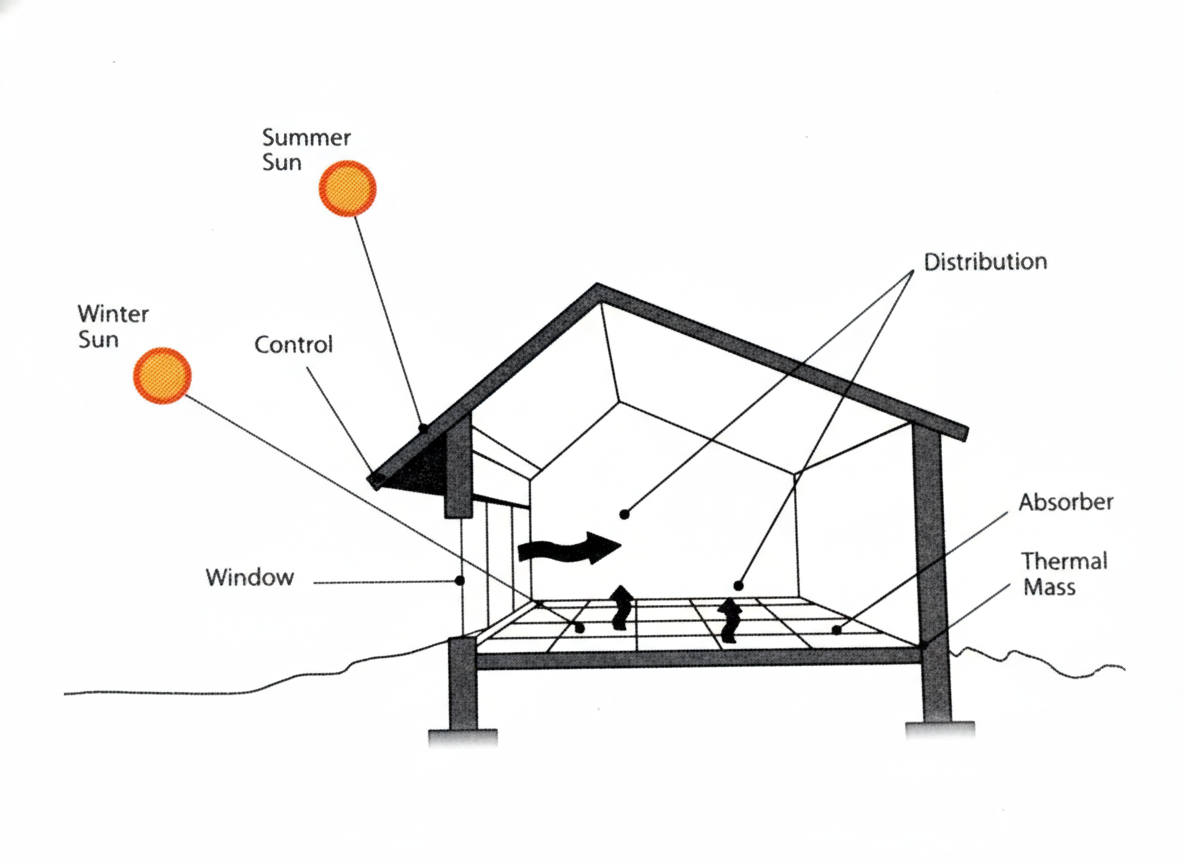
Passive solar works through five integrated elements. All five matter.
Orientation: The long axis of your home runs east-west. Living spaces face south. This gets decided before your architect draws a single line.
South-Facing Windows: 7 to 12 percent of your total floor area should be south-facing glass. In the Boise Valley, 9 to 10 percent is optimal.
Thermal Mass: Concrete floors, masonry walls, or straw bale walls absorb heat from south-facing windows during the day. At night, that thermal mass releases stored heat. Straw bale is both thermal mass and insulation, which is why it performs exceptionally in passive solar design.
Insulation and Air Sealing: You need R-45 walls minimum. Most custom homes are R-20. R-45 walls plus air sealing means your home holds temperature naturally.
Overhangs and Shading: At 43.6 degrees north (Boise), a 2-foot overhang blocks summer sun perfectly while allowing winter sun in.
How It Works in an Idaho Winter
January in the Boise Valley. Outside temperature is 35 degrees. Sun is shining (200+ days of sunshine). Your south-facing windows capture that low-angle solar radiation. Concrete floor or straw bale walls absorb the heat. Interior temperature rises to 68 to 72 degrees.
At night, outside temperature drops to 20 degrees. But your R-45 walls and tight air sealing keep that cold out. The thermal mass slowly releases captured heat. Your home stays warm without running a furnace.
This is not theory. Our Squaw Butte project documented zero HVAC usage from January through March 2023. Three months of Boise Valley winter on a single wood-burning stove.
Why Most Builders Don't Do This
Passive solar design requires thinking before drawing. You can't design it in two weeks. You can't add it as an afterthought.
Most builders design homes then try to make them passive solar. That's backwards. Passive solar design drives every decision from the first conversation: lot orientation, home orientation, window placement, thermal mass location, insulation specification, overhang depth.
At EarthCraft, we've been doing this since 1978. Ron Hixson pioneered passive solar design in Idaho before "green building" was even a term. We don't add passive solar to a design. We design the home for passive solar from the beginning.
The Financial Case
Heating costs in a conventional home: $150 to $300 per month in winter. Over a 7-month heating season, that's $1,050 to $2,100. Over 30 years, $31,500 to $63,000.
Heating costs in a passive solar home: $30 to $50 per month in winter (mostly backup). Over 30 years, $6,300 to $10,500.
The difference: $25,000 to $52,500 over 30 years. For a home built at the same upfront price.
If you're serious about a custom home in Idaho and want to eliminate heating costs, passive solar design from the beginning is how you do it.
