Will a Straw Bale Home Survive a Wildfire? What the Fire Testing Actually Shows
Will a Straw Bale Home Survive a Wildfire? What the Fire Testing Actually Shows
When people first hear “straw bale home,” the question comes almost immediately. Straw burns. So how does a house made of straw survive a wildfire?
It is a fair question, and it deserves a real answer instead of a sales pitch. Here is the honest version, backed by national laboratory testing and what we have seen with our own eyes.
A loose pile of straw burns fast. Spread it out, give it oxygen, and it goes up in seconds. But a straw bale wall is not a loose pile of straw. It is straw compressed into dense bales, stacked, and then sealed inside lime or earthen plaster. That changes everything about how it behaves in a fire.
Fire needs oxygen. A tightly packed bale does not have enough air moving through it to sustain combustion. The same way a thick phone book resists burning while a single loose page lights instantly, dense straw chokes the fire before it can spread. Then you add an inch or more of plaster on each side. Lime plaster does not burn. It is a mineral coating that acts like a shield, the same principle behind the fireproofing on structural steel in commercial buildings.
The result is documented, not theoretical. Straw bale wall assemblies have been tested under ASTM E-119, the same fire-resistance standard used to rate commercial construction. Plastered straw bale walls have withstood direct flame for two hours or more before structural failure. Most conventional wood-framed walls do not come close to that number. The wood studs in a standard home are the fuel. In a straw bale wall, the structure is protected behind a non-combustible skin.
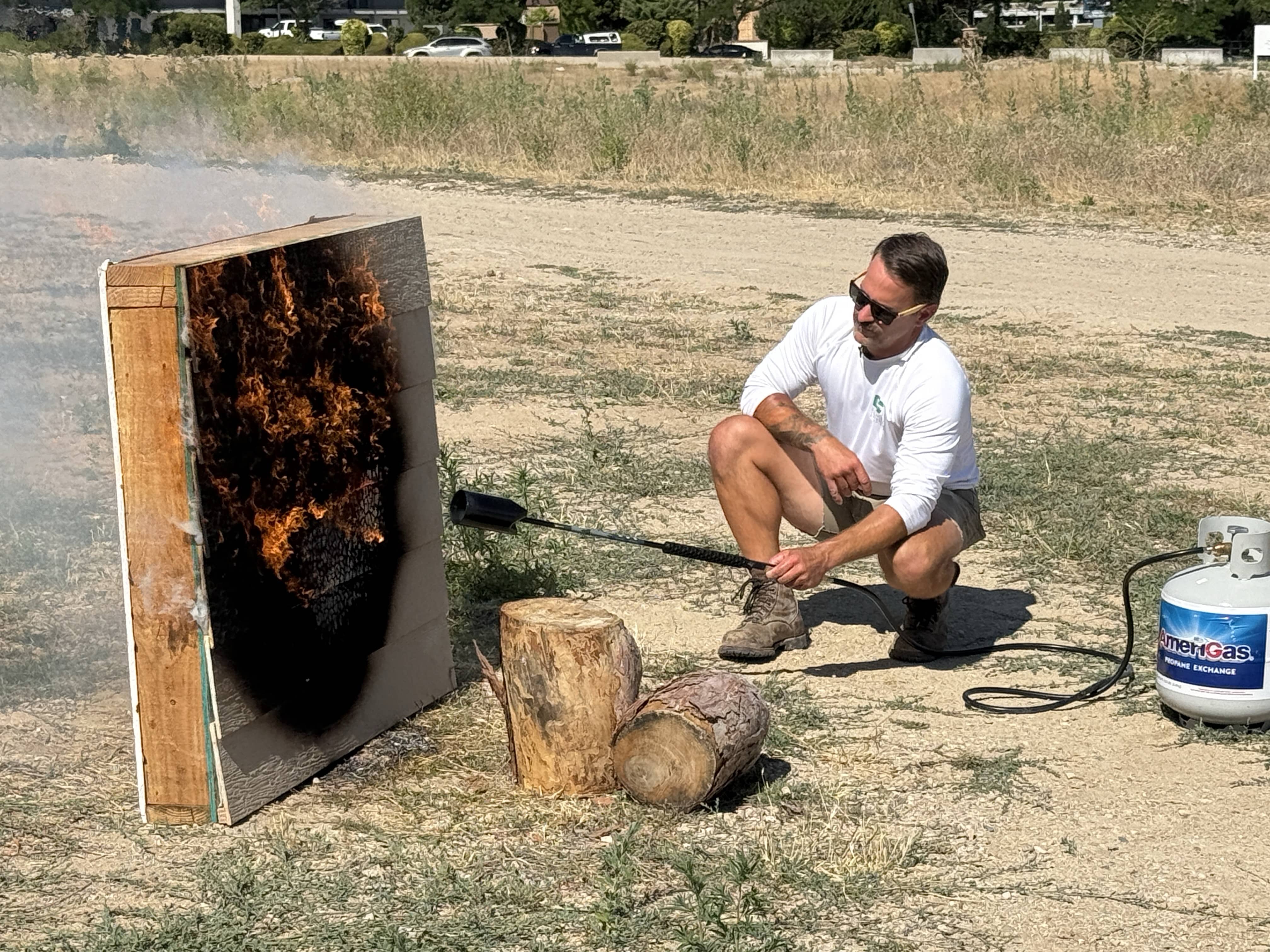
We have seen this firsthand. At our Learn and Burn events, we take a finished plastered bale wall section and put a torch to it in front of a live audience. People expect a bonfire. What they get is char on the surface of the plaster and a wall that is still standing, still sound, when the flame comes off. It is one thing to read a test report. It is another to watch a wall refuse to burn.
This matters more in Idaho than almost anywhere. Wildfire season is part of life in the Boise Valley and the foothills now. Families building on acreage in the wildland-urban interface are right to think hard about it. We have rebuilt for clients who lost a conventional home to fire and decided that the replacement would not burn the same way. When you are building in fire country, the wall system is not a detail. It is one of the most important decisions you will make.
A straw bale home does not give you a fireproof house. Nothing is fireproof, and any builder who tells you otherwise is selling something. What it gives you is a wall assembly that buys time, resists ignition, and outperforms conventional framing under the same test conditions. Combine that with smart site design, defensible space, a metal roof, and careful detailing around windows and eaves, and you have a home built to stand in a landscape that burns.
The straw inside the wall is also doing other work the entire time it is protecting you. Those same dense, plastered bales deliver R-45 insulation, the kind of thermal performance that ran our Squaw Butte project with zero mechanical heating from January through March of 2023. The fire resistance is not a trade-off against comfort or efficiency. You get all of it from the same wall.
So when someone asks whether a straw bale home can survive a wildfire, the better question is which wall they would rather be standing behind. The one made of exposed wood studs, or the one tested to two hours of direct flame and proven in front of a crowd with a torch. The data points one direction. So does common sense once you understand how the wall is actually built.
If you are planning a custom home anywhere near Idaho fire country, this is worth a real conversation before you finalize your design. Build it right the first time, and you build it to last through the seasons this valley actually throws at it.
