
A Good Hat and Good Boots: Why the Roof Does More Than You Think
A Good Hat and Good Boots: Why the Roof Does More Than You Think
Why Does Roof Design Matter So Much on a High-Performance Home?
Most people think of a roof as the thing that keeps the rain out. It does that, of course. But on a high-performance home, the roof is doing far more work than shedding water, and the decisions made about it, especially the overhangs, ripple through the comfort, durability, and energy performance of the entire house. A roof designed with intention is one of the quiet workhorses of a well-built home. A roof treated as an afterthought quietly costs you for decades.
Understanding what the roof actually does changes how you look at it. It stops being a cap on top of the walls and becomes an active part of how the home performs.
Overhangs are the sun's on-off switch
The single most important thing a roof does on a passive solar home happens at the overhangs. A properly sized overhang is what lets a south-facing home welcome the winter sun and reject the summer sun, using nothing but geometry.
In winter, the sun tracks low across the southern sky, and a well-designed overhang lets that low sun slip in beneath it to warm the home. In summer, the sun climbs high overhead, and the same overhang shades the windows and walls from that high sun, keeping the home cool. One fixed piece of the roof, no moving parts, doing opposite jobs in opposite seasons. This is one of the most elegant ideas in all of building, and it lives entirely in how the roof is designed and sized. Get the overhang depth right and the house heats and cools itself far more than most people believe possible. Get it wrong and you either lose winter warmth or cook in summer.
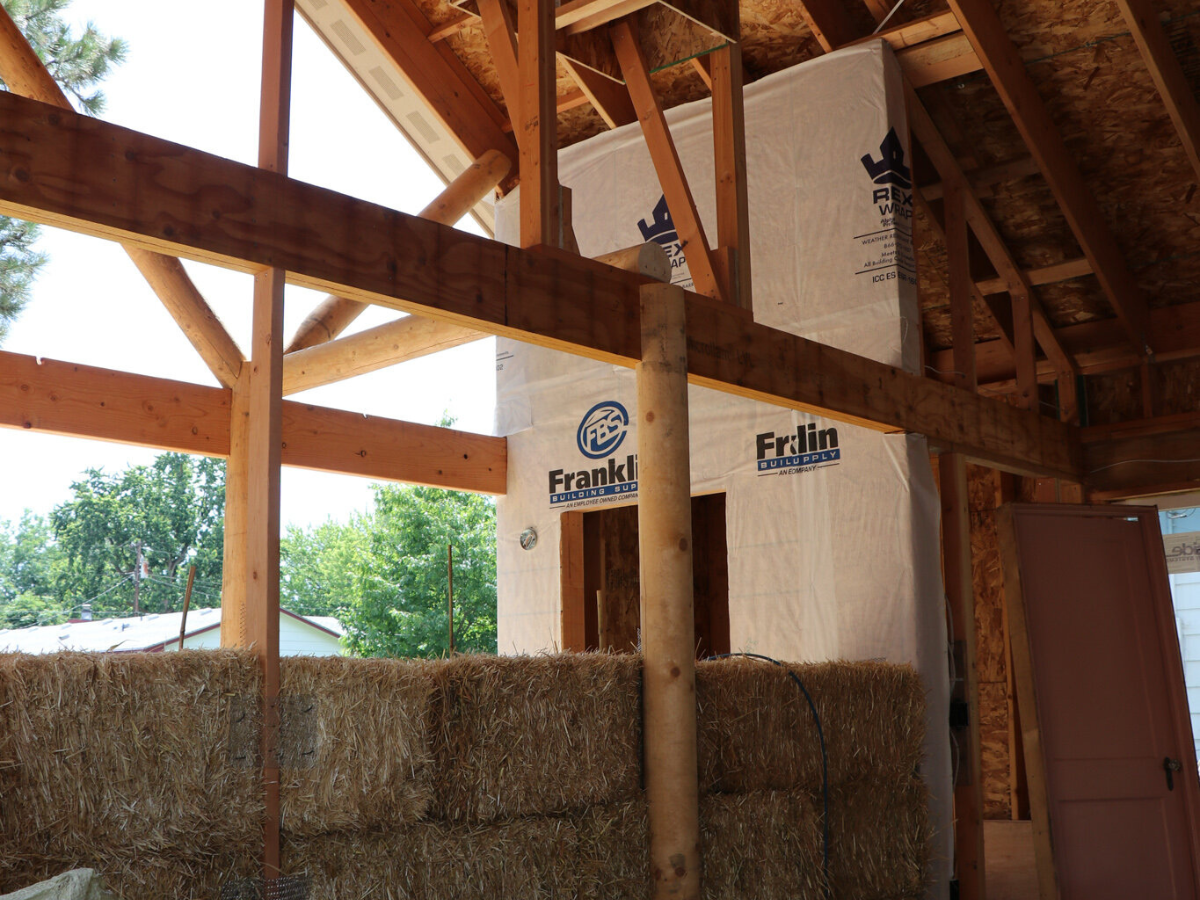
Overhangs protect the walls
The second job overhangs do is protect the walls, and this matters even more on a home with natural plaster surfaces. A generous overhang keeps rain and weather off the walls, letting the water fall well clear of the building instead of running down its faces.
This is classic, time-tested building wisdom, sometimes described as giving a home a good hat and good boots. The boots are the raised, protected base of the wall. The hat is the roof with its generous overhangs. Together they keep water away from the two places a wall is most vulnerable, the top and the bottom. For any home this is smart. For a home whose walls you intend to last well over a century, it is essential. The overhangs are a big part of why a well-built natural home sheds weather so effortlessly and ages so well.
The roof as part of the envelope
Beyond the overhangs, the roof is a major part of the home's thermal envelope, and it deserves the same performance thinking as the walls. Heat rises, and a poorly insulated roof is one of the biggest places a home loses warmth in winter and gains it in summer. A high-performance home carries its commitment to a tight, well-insulated envelope all the way up and over the top.
That means the roof assembly is designed to insulate deeply and perform as well as the walls it sits on. A home with superb R-45 walls and a weak roof is like a warm coat with no hat. The roof completes the envelope, and on a home built to hold its temperature, it has to be as considered as everything below it.
Form and function together
There is an aesthetic dimension too, and on a well-designed home it is inseparable from the function. Roof lines shape the entire character of a house. The pitch, the way the roof meets the walls, the depth and shadow of the overhangs, all of it is doing real work and shaping how the home looks at the same time.
This is the pleasure of designing a roof with intent. The overhangs that shade your summer windows also cast beautiful shadow lines across the walls. The generous eaves that protect the plaster also give the home a grounded, sheltering look. Good design does not force a choice between a roof that performs and a roof that looks right. Done well, the two are the same decision, and the roof that works best is very often the one that looks best too.
Designed from the top down
All of this is why the roof cannot be an afterthought bolted on once the rest of the home is drawn. Overhang depth depends on the latitude, the sun angles, and the exact windows below. Roof insulation has to integrate with the wall assembly so the envelope is continuous. The roof lines have to serve both the performance and the look of the whole home. These are connected decisions, best made as part of designing the entire house at once.
That is exactly the kind of integration a design-build approach is built to deliver. When the same team designs the walls, places the windows, sizes the overhangs, and details the roof, everything lines up. The overhang that shades the July sun is the same overhang that protects the plaster and completes the look. The roof insulation meets the wall insulation with no gap. The result is a home where the roof is pulling its full weight, protecting the walls, managing the sun, sealing the envelope, and crowning the whole design, all at once. That is a roof doing its real job, and it is a great deal more than keeping the rain out.
