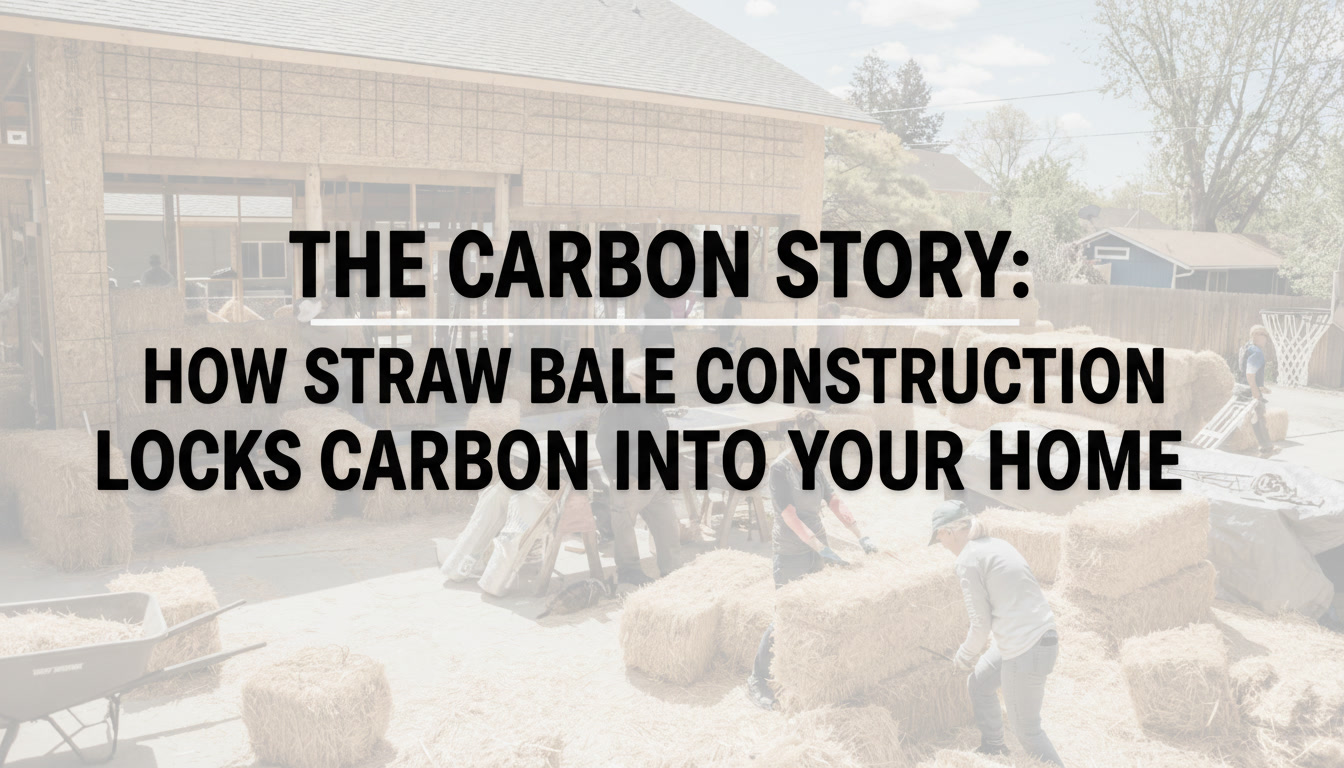
The Carbon Story: How Straw Bale Construction Locks Carbon Into Your Home
The Carbon Story: How Straw Bale Construction Locks Carbon Into Your Home
Most conversations about a home’s environmental footprint stop at energy efficiency. How much power it uses, how low the utility bills run. That matters, and our homes do exceptionally well on it. But there is a second story that almost nobody tells, and for a growing number of our clients it is just as compelling. It is the story of the carbon locked inside the walls themselves, decided the day the home is built and never undone.
Every building carries two kinds of carbon. There is operational carbon, the emissions from heating, cooling, and powering the home over its life. And there is embodied carbon, the emissions baked into the materials themselves, from how they were made and transported. A high-performance home already wins on operational carbon by using very little energy. Straw bale construction also wins, dramatically, on the embodied side, and that is the part of the story worth telling.
Consider what conventional homes are built from. Concrete and steel are two of the most carbon-intensive materials on earth. Manufacturing cement alone is responsible for a large share of global carbon emissions. Spray foam insulation is a petroleum product. Every one of these materials arrives at your building site having already released significant carbon into the atmosphere just to exist. That carbon is spent before the first wall goes up, and you cannot get it back.
Straw works the other way. While a wheat plant grows, it pulls carbon dioxide out of the air and stores it in the stalk. That is what photosynthesis does. When we build with the straw, that carbon does not get released. It gets locked inside your wall, sealed in plaster, held there for the entire life of the home. A straw bale wall is, in effect, a carbon vault. The longer the home stands, and a well-built straw bale home stands for a century or more, the longer that carbon stays out of the atmosphere. This is why straw bale is described as a carbon-negative building material. It stores more carbon than its production releases.
There is a local angle that makes it even better. The straw we build with is an agricultural byproduct. After the grain is harvested, the leftover stalk often has little use, and in many places it is simply burned in the field, which releases its carbon straight back into the air. Building with it instead captures that carbon and gives a waste product a second life as a high-performing wall. And because Idaho farms grow grain, the straw can be sourced close to home, which keeps transportation emissions low and supports the agricultural community right here in the valley. Wheat straw regenerates every single year, so it is genuinely renewable in a way that concrete and steel will never be.
For the clients this resonates with, this is not abstract. Many of the families we build for think in generations. They are building a home they intend to pass down, and they want that home to reflect their values in a way that lasts. A carbon-negative wall is a value made permanent. It is not a sticker on the window or a certificate in a drawer. It is built into the structure, doing its quiet work every day, for as long as the home stands.
It is also worth being clear-eyed and honest, which is the only way we talk about environmental claims. Building any home has a footprint. There is concrete in the foundation, glass in the windows, steel in the connections. We are not going to pretend a straw bale home is carbon-free, because it is not, and overstating it would be the kind of greenwashing we have no interest in. What is true, and what the building science supports, is that straw bale construction has a far lower embodied carbon footprint than conventional construction, and that the straw itself stores carbon rather than emitting it. The whole package, low operational carbon from high performance plus low embodied carbon from natural materials, is about as good as residential construction gets.
The wider world is starting to recognize this. Some states have begun offering incentives for building with carbon-sequestering materials, and as carbon becomes a more serious part of how buildings are evaluated, the homes built this way will be ahead of the curve rather than behind it. Building a straw bale home today is a decision that looks better, not worse, as the years go on.
So when you think about the environmental story of a home, do not stop at the utility bill. Look at the walls themselves. In a straw bale home, those walls are holding carbon out of the sky for a hundred years, built from a renewable crop grown down the road, doing good quietly every day you live there. That is a story most homes can never tell.
If building with materials that reflect that kind of thinking matters to you, it is exactly the kind of conversation we love to have at the start of a project.
