
The Storm Becomes a View
The Storm Becomes a View
What Does a Straw Bale Home Sound Like Inside During a Storm?
There is a moment people describe again and again after their first night in a straw bale home. A storm rolls through the Boise Valley, wind pushing hard against the house, rain driving against the windows, and inside, almost nothing. The weather is out there doing its work, and the house sits in a pocket of calm that feels almost separate from it. It is one of those experiences that no spec sheet prepares you for, and it stays with people.
We have written before about how these walls handle sound between rooms. This is a different thing. This is about what happens to the world outside when it meets eighteen inches of straw and plaster, and why a storm becomes something you watch rather than something you endure.
The weather arrives softened
Start with what a storm actually is at the wall. Wind, rain, hail, the rush of a downpour, all of it is energy hitting the outside of your home. In a conventional house, that energy passes through a thin wall with very little to stop it. You hear the wind find every gap. You hear rain drum on the structure. The weather is present inside the house, a constant background you tune out only because you are used to it.
A straw bale wall meets that same weather with a dense, thick, layered mass. Sound simply does not pass through it the way it passes through a thin framed wall. The energy of the storm gets absorbed and dissipated in the depth of the wall before it ever reaches the inside. What arrives in the room is a softened, distant version of what is happening outside. The storm is still there. You know it is there. But it reaches you as a hush instead of a roar.
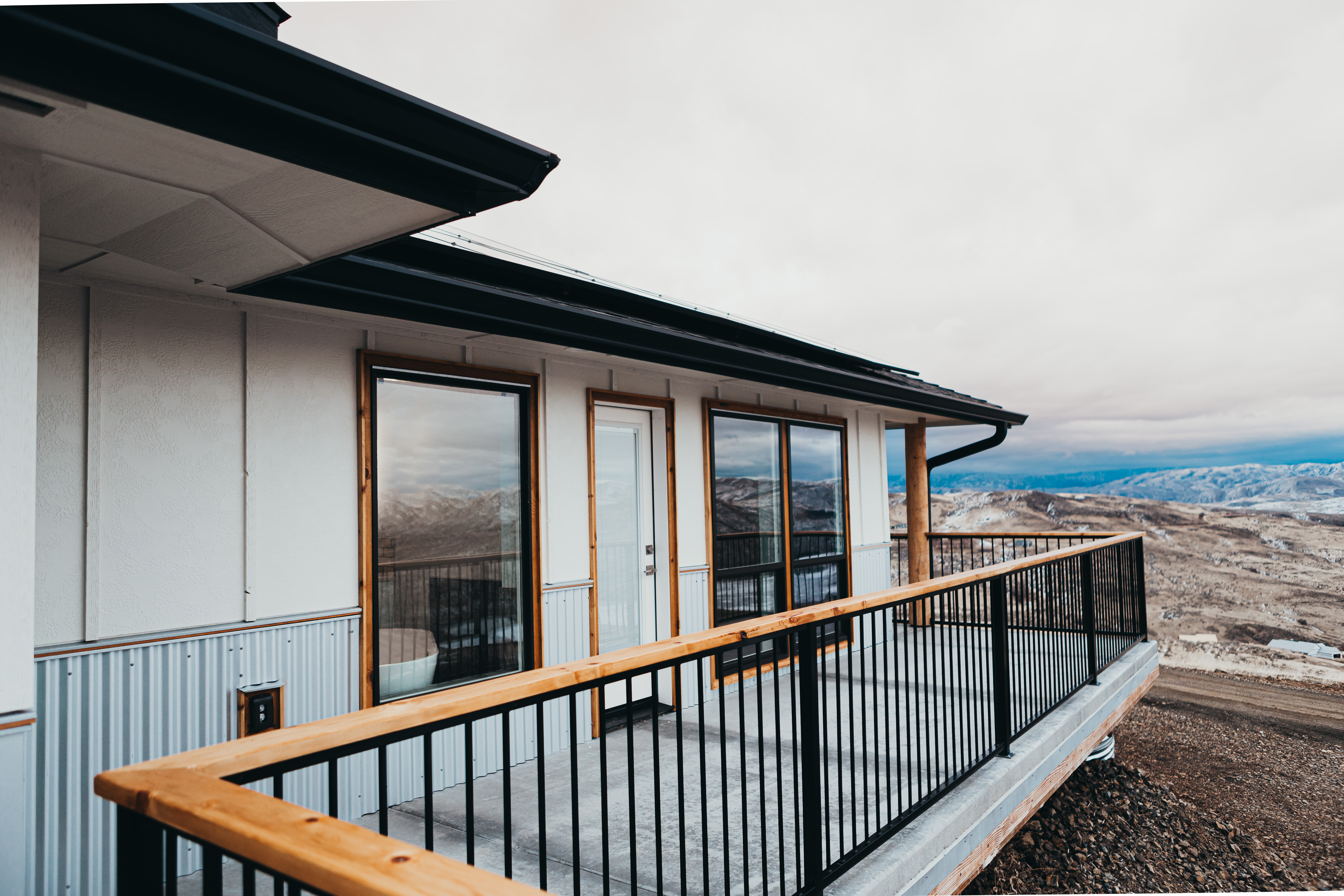
A pocket of calm
The effect on daily life is hard to overstate until you have lived it. A hard Idaho wind that would rattle a conventional house barely registers inside a bale home. A downpour becomes a soft sound at the windows rather than a drumming overhead. Even hail, which announces itself violently on most homes, arrives muffled and far away.
What this creates is a genuine sense of shelter, the old, deep meaning of the word. Your home becomes a refuge from the weather in a way that goes beyond simply keeping the rain off. It keeps the chaos of the weather out too. The house holds a pocket of calm, and you sit inside it while the season does whatever it is going to do. People talk about sleeping better, about storms becoming something cozy rather than stressful, about a quality of peace they did not know a house could provide.
Why the whole wall does this
This calm is not a single feature. It is the same thick, solid wall assembly doing several things at once, and the quiet is one of the most immediately noticeable.
The mass of the bales, the density of the plaster on both faces, the sheer thickness of the assembly, all of it that makes the wall insulate against heat also makes it insulate against sound. A wall built to hold a winter's warmth inside is, by its nature, a wall that holds a storm's noise outside. You do not pay extra for the quiet. It comes along with everything else the wall is doing, a free and profound benefit of building thick and solid and natural.
The windows play their part too. In a high-performance home, the glazing is already chosen to be substantial for thermal reasons, and substantial glazing is also better at keeping weather noise out. So the few openings in the wall are not the weak points for sound that thin single-pane windows would be. The whole envelope, walls and openings together, works to keep the outside outside.
The kind of quiet you feel
There is something worth naming about what this quiet does to a person over time. We live surrounded by more noise than we consciously register, and a lot of it comes from outside our homes. Traffic, wind, weather, the general hum of the world. When a house genuinely holds that at bay, the nervous system notices even when the mind does not. People describe a straw bale home as restful in a way they struggle to explain, and a good part of that is simply the absence of the low, constant noise they were carrying without knowing it.
A storm makes it obvious because the contrast is so sharp. But the same quiet is there every day, in the background, doing its quiet work on how it feels to be home.
Shelter in the fullest sense
A home is supposed to shelter you. Most of the conversation about that focuses on temperature, on keeping you warm and dry. But real shelter is more than that. It is the feeling of being genuinely held apart from the weather, of having a calm place to be while the world outside does what it does. A straw bale home delivers that in a way you feel in your body the first time a real storm rolls through and you realize you can barely hear it.
So when the wind comes up the valley and the rain starts to drive, a straw bale home does something quietly remarkable. It turns the storm into a view. You watch it through the deep-set windows, you hear it only faintly, and you sit in the calm the walls have made. That is shelter in the fullest sense of the word, and it is one of the things people end up loving most about living inside walls like these.
