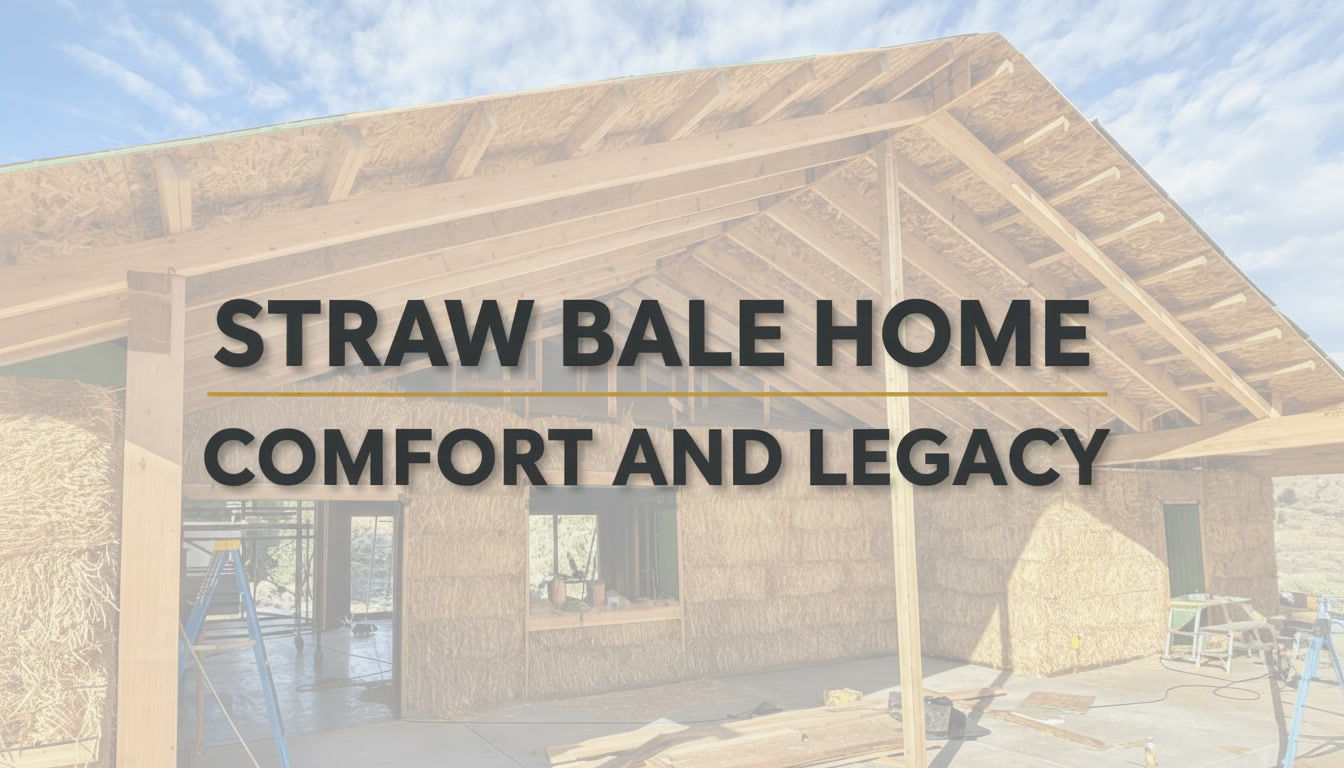
What Makes a Straw Bale Home Worth the Investment: Long-Term Value, Comfort, and Legacy
What Makes a Straw Bale Home Worth the Investment: Long-Term Value, Comfort, and Legacy
People wonder if straw bale is a risky bet or a smart investment. The answer depends on how you measure value.
If you're measuring value as "will I get 100 percent of my money back in resale," straw bale might not be the answer. If you're measuring value as "what will serve my family for generations, keep my family healthy, cost less to operate every month for 30+ years, and be built from renewable materials," then straw bale is not just worth it. It's the only real choice.
It's Not About Resale Value (It's About Legacy)
Straw bale's resale value is improving as awareness grows. But that's not the reason to build straw bale. The reason is durability and legacy.
Straw bale structures built in Nebraska in the 1890s are still standing and occupied. Not abandoned. Not historical curiosities. Occupied family homes. Some are a century and a quarter old and still performing. Try finding a conventional home from 1900 that's still being lived in without major renovation.
When you build straw bale, you're building something your grandchildren could inherit and live in without modifications. That's not measurable in resale value. That's measured in legacy.
The Operating Cost Reality
Your straw bale home costs $30 to $80 per month to heat and cool. Your neighbor's conventional home costs $150 to $300 per month. That's $1,440 to $3,240 per year. Over 30 years, that's $43,200 to $97,200 in utility savings alone.
That's not a luxury. That's financial reality. That's money that goes to your family instead of the power company.
At EarthCraft, our Squaw Butte project documented zero HVAC usage from January through March 2023. Three months of Boise Valley winter with no mechanical heating. Just passive solar design and straw bale thermal mass. The utility savings from those three months alone would fund a significant portion of the straw bale material upgrade over conventional construction.
The Health Investment: Air Quality
Straw bale homes have among the healthiest indoor air quality of any building design in the world. Not because of marketing. Because of material science.
Straw itself off-gasses nothing. No VOCs. No formaldehyde. Lime plaster (standard for straw bale) is non-toxic and breathable. Unlike drywall and paint, it doesn't trap moisture. It allows walls to vapor-open and dry naturally.
Conventional homes use spray foam insulation (off-gasses for years), drywall with paint (VOCs), and engineered cabinetry (formaldehyde). The air quality difference is not subtle. First-time visitors to straw bale homes consistently comment that the air feels different. Cleaner. Lighter. That's measurable indoor air quality.
If you have family members with asthma, allergies, or respiratory sensitivity, straw bale air quality matters.
The Durability Story: Built to Last
Straw bale homes are vapor-open. Moisture that gets in also gets out. That's the opposite of conventional construction, where moisture gets trapped and creates mold. Straw bale does not have mold problems when built correctly because the wall system breathes.
Fire resistance is exceptional. ASTM E-119 tested at 2+ hours of direct flame resistance. After California wildfires, builders started rebuilding with straw bale specifically because of fire performance.
Rodents don't burrow into compressed straw bales. The bales are too dense. Straw has no nutritional value. The plaster shell seals all sides. Fewer entry points than conventional framing.
Durability isn't a marketing claim. It's physics. It's material science. It's a century-plus of standing structures proving the concept.
The Environmental Investment: Carbon Negative
Straw is a renewable agricultural byproduct. It sequesters more carbon than any other natural insulation material. When you build with straw, you're using a material that actively removes carbon from the atmosphere and locks it into your home.
Conventional insulation (fiberglass, spray foam) is made from petroleum products. Mining and manufacturing has environmental cost. Straw is sourced locally from Idaho farms, processed locally, installed locally. The carbon footprint is negligible compared to conventional options.
You can lie in bed at night knowing your home is carbon-negative. Not neutral. Negative. Your home is actively removing carbon from the atmosphere. That matters if you care about the world your grandchildren will inherit.
What You're Actually Investing In
When you choose straw bale construction, you're paying for:
A home that will serve your family for 100+ years without major renovation. Monthly utility costs 30 to 90 percent lower than conventional homes. Indoor air quality healthier than outside air. Thermal comfort that's stable and consistent year-round. Fire resistance that exceeds conventional construction. A structure that sequesters carbon. Natural, breathable materials that support human health.
At EarthCraft, we've been building straw bale homes for four decades because Ron Hixson understood something the rest of the industry is only now catching up to: building with natural materials is not a compromise. It's an upgrade.
The resale value question is the wrong question. The right question is: what do you want your home to do for your family over the next 100 years? What do you want your grandchildren to inherit? What kind of environmental legacy do you want to leave?
If straw bale answers those questions, then the investment is not a risk. It's clarity.
