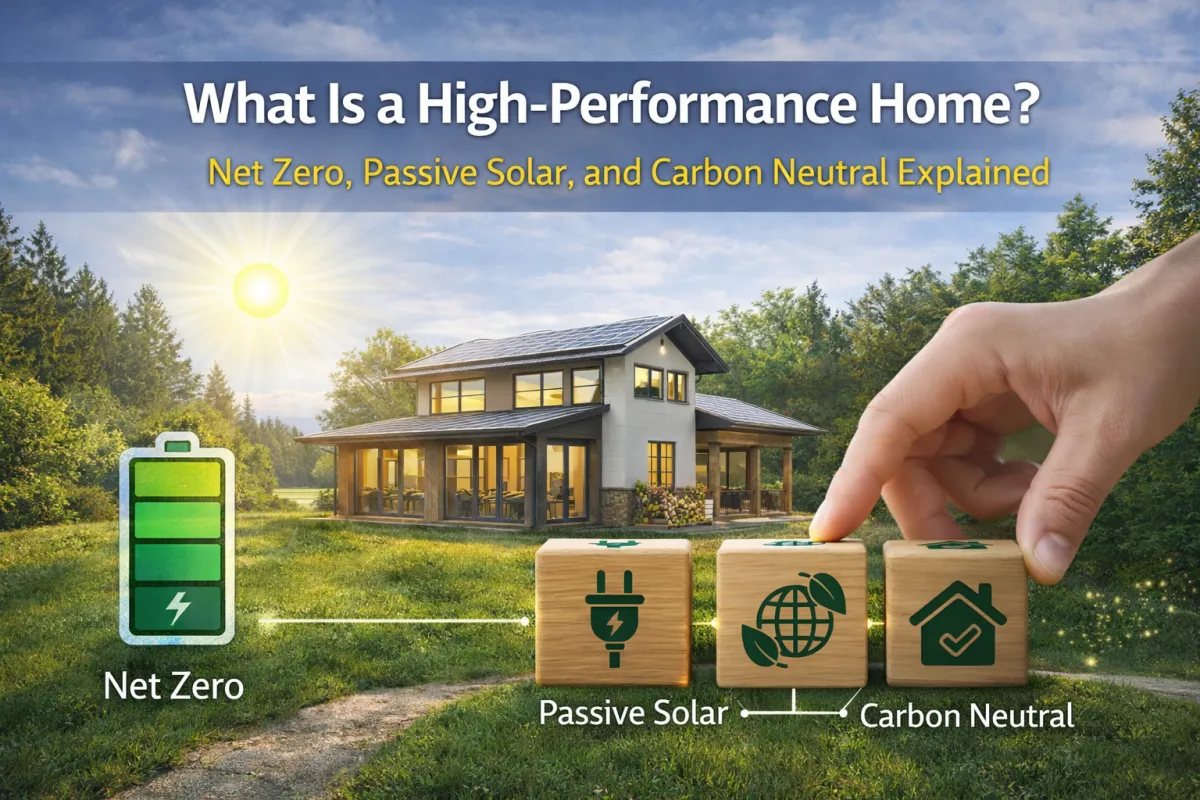
What Is a High-Performance Home? Net Zero, Passive Solar, and Carbon Neutral Explained
What Is a High-Performance Home? Net Zero, Passive Solar, and Carbon Neutral Explained
There are a lot of terms floating around in the building industry right now that sound impressive but can be confusing when you are trying to figure out what actually matters for your family. Net zero. Carbon neutral. Passive solar. High-performance. Passive House. Green building. These are not interchangeable terms, and understanding the differences matters if you are going to make informed decisions about how your home is built.
Let me break these down in plain language, because this is what we do every day, and I think you deserve clarity instead of buzzwords.
A high-performance home is one that aspires to exceed minimum building code standards across multiple categories. We are talking about indoor air quality, energy use, sound performance, even temperature distribution, durability, and overall comfort. Building code is the floor. It is the minimum legal requirement. A high-performance home is built well above that floor in every measurable way.
At EarthCraft Construction, high-performance is not an upgrade package or a premium option. It is how we build. Every home. Every project. R-30 to R-45 insulation in straw bale walls. Passive solar orientation. Careful air sealing. Quality mechanical systems sized correctly for the building envelope. These are standard for us, not extras.
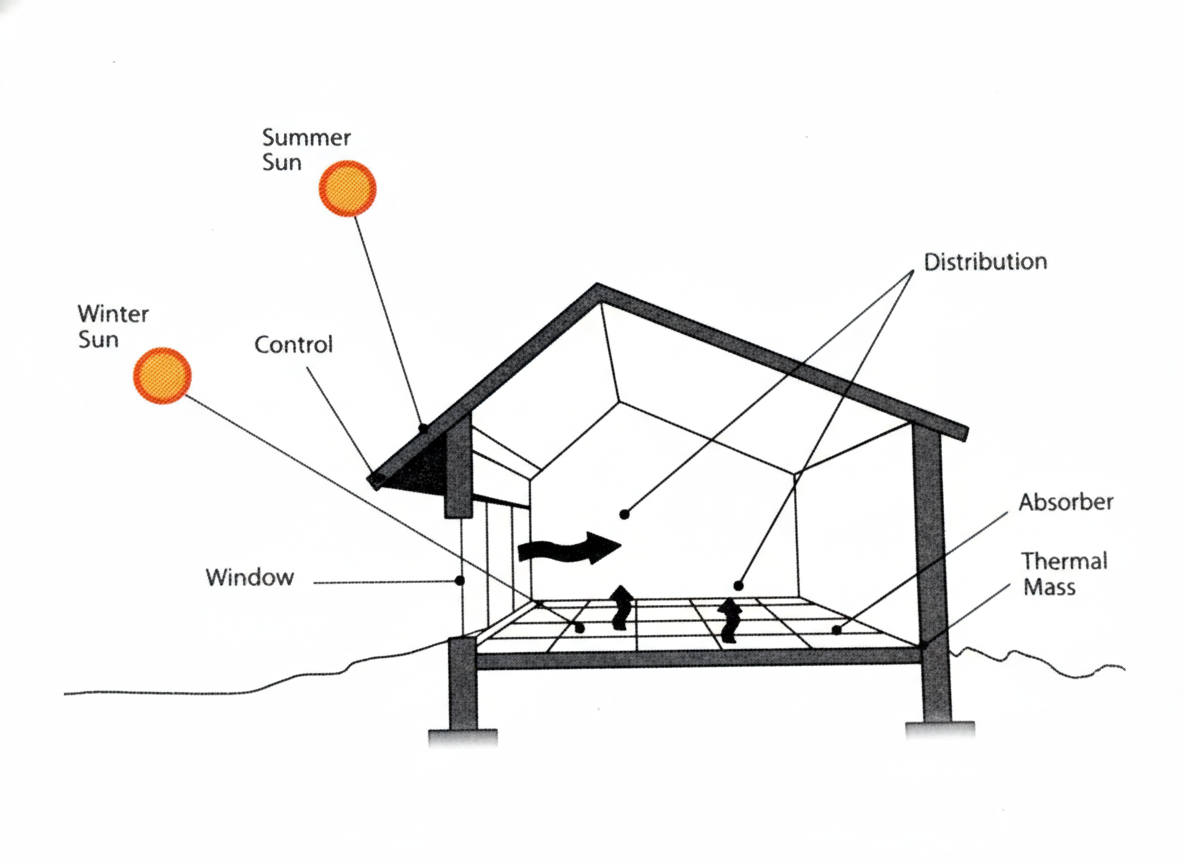
Passive solar design is one of the most powerful and least understood strategies in residential construction. In simple terms, a passive solar home collects heat as the sun shines through south-facing windows and retains it in materials that store heat, known as thermal mass. Concrete floors, masonry walls, even water features can serve as thermal mass. The home is oriented and designed so that winter sun penetrates deep into the living spaces, warming the thermal mass during the day. That stored heat then radiates back into the home during the evening and nighttime hours.
This is not high-tech. It is actually ancient technology applied with modern precision. Proper passive solar design reduces heating loads dramatically without any moving parts, fuel, or electricity. It is free energy from the sun, captured by smart design. We incorporate passive solar principles into every type of construction we do. Even a traditional-looking home can benefit significantly from passive solar orientation.
Our Emmett straw bale project is a clear example of what this looks like in practice. That home went through three months of Idaho winter with no HVAC system running, heated entirely by passive solar gain and a single wood-burning stove. That is passive solar design doing what it is supposed to do.
Net zero takes the high-performance concept further. A net zero home is connected to the grid and designed to be so energy efficient that it generates as much renewable energy as it uses annually. The result is a net-zero energy bill. You are still using the grid, but over the course of a year, you are putting back as much energy as you are taking. This is achieved through a combination of extremely efficient building envelope design, right-sized mechanical systems, and on-site renewable energy generation, typically solar panels.
Carbon neutral means balancing the carbon dioxide emitted during the building process and the home's operation with an equivalent amount of carbon absorbed or offset. This is where straw bale construction has a powerful advantage that most other building systems cannot match. Straw bales are a carbon-negative building material. The straw sequestered carbon from the atmosphere while it was growing as a crop. When that straw is locked into your walls, that carbon stays locked away for the life of the building. Straw bales store more carbon than any other natural insulation material.
So when you build with straw bale, you are starting from a position where your wall material has already pulled carbon out of the atmosphere. Combine that with high-performance design that minimizes operational energy use, and you have a home that is working for the environment from the day it is built.
I want to be honest about something. These terms have been used loosely in the industry, sometimes as marketing more than substance. We believe in transparency. When we say a home is high-performance, we mean we can point to specific data. R-values. Air changes per hour. Energy consumption tracked over actual seasons. Certifications from bodies like LEED or Passive House when clients pursue them. We are not interested in greenwashing. We are interested in building homes that actually perform.
The reason I am passionate about this is not because the terminology sounds good on a website. It is because I see the tangible difference it makes in people's lives. Families living in homes that are comfortable year-round. Energy bills that are a fraction of their neighbors'. Indoor air that is clean and healthy. A home that they know is going to serve them and their children for the rest of their lives.
That is what high-performance building means to us. It means creating an environment where your family is going to live, have experiences, and grow up in something that is built to the highest possible standard. Not because code requires it, but because your family deserves it.
