Your Walls, Grown Down the Road
Your Walls, Grown Down the Road
Where Does the Straw in a Straw Bale Home Actually Come From?
People are often surprised to learn how ordinary the answer is. The straw in a straw bale home is not grown specially, not manufactured, not shipped in from somewhere exotic. It is the leftover stalk from growing grain, the part the farmer has already finished with, baled up and ready to become a wall. In Idaho, that means it comes from right around here.
Understanding what the material actually is clears up a lot of confusion at once, and it explains why straw bale sits so naturally at the center of how we think about building.
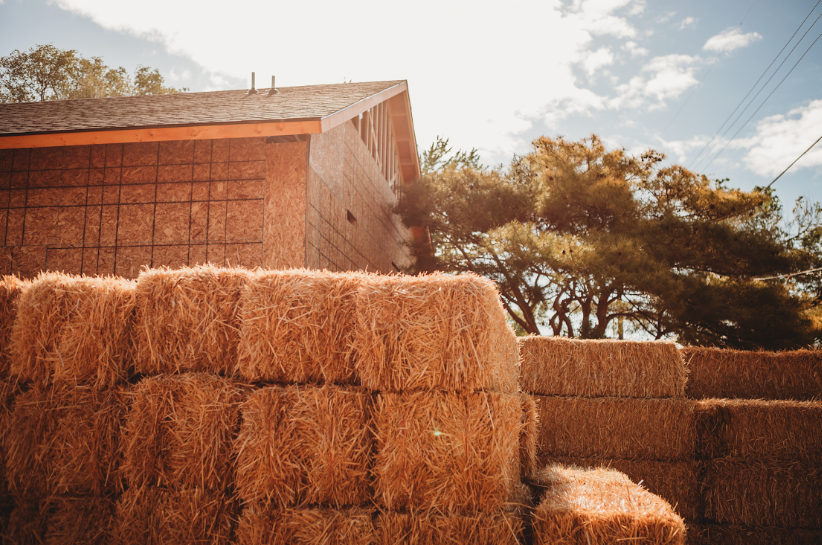
Straw is not hay, and it is not the grain
First, the confusion that trips almost everyone up. Straw is not hay. Hay is a whole plant grown as animal feed, cut green and full of nutrition. Straw is something else entirely. It is the dry, hollow stalk left standing after a grain crop like wheat or barley has been harvested and the actual grain has been taken off for food.
So the straw is the part that is left over once the valuable food crop is gone. It is the stem, dried out, with the nutrition already removed and sent off to the kitchen table. This distinction matters more than it sounds, because it explains one of the best things about straw as a wall. There is nothing in it for pests to eat. The food already left. What remains is essentially a dry, hollow structural fiber, which happens to be exactly what you want in an insulating wall and exactly what you do not want if you are a mouse looking for a meal.
A byproduct, not a purpose-grown crop
Here is the part that makes straw bale so appealing to anyone who thinks about resources. The farmer did not plant the field to make your walls. They planted it to grow food. The straw is the byproduct, the material that is produced whether or not anyone ever builds with it.
Every grain harvest leaves enormous quantities of this stalk behind. Historically a lot of it is simply surplus, something the farmer has to deal with. Building with it takes a genuine agricultural leftover and turns it into a permanent, high-performing wall. You are not consuming a resource that had to be created for the purpose. You are making use of one that already exists as a consequence of feeding people. That is about as efficient as a building material gets.
Grown locally, used locally
In our case, the straw comes from Idaho farms. This is a quiet advantage that stacks several benefits at once. The material is grown close to where the home is built, so it does not travel far to reach the site. A locally sourced byproduct means low transportation, dollars staying in the regional agricultural economy, and a direct, traceable connection between the land the grain grew on and the walls of the home.
There is something fitting about a home in the Boise Valley being insulated by the stalks of grain grown in the same region. The house is, in a real sense, made of its own landscape. That is not a marketing flourish. It is just what happens when you build with a local agricultural product instead of materials manufactured in distant factories and trucked across the country.
Why this is the heart of the whole philosophy
This is where the material connects to something bigger. Building with a renewable, local, annually regrowing byproduct is the practical expression of a conservationist way of thinking. Grain grows back every single year. The straw is produced again with every harvest, endlessly renewable in a way that mined and manufactured materials never are. And rather than being wasted, it gets locked into a wall where it will do good work for well over a century.
That mindset, using what the land already produces and wasting nothing, runs straight through everything EarthCraft is. It is the reason we build with straw in the first place. Ron carried that use-what-you-have ethic through his whole life, and it is alive in every bale that goes into a wall. Taking the humble leftover of a food harvest and making it into a durable, beautiful, high-performance home is not a compromise. It is the entire point.
An honest material
So when someone asks what straw bale really is, the honest answer is almost humble. It is the dried stalk left over after Idaho farmers grow grain for food. Renewable every year, produced locally whether we use it or not, with the food already gone so there is nothing to attract pests, and hollow and fibrous in exactly the way that makes a superb insulating wall.
There is nothing exotic about it. That is precisely what makes it remarkable. One of the most durable, comfortable, and environmentally sound ways to build a home starts with a material a farmer down the road would otherwise have to figure out what to do with. We just recognized what it could become.
