The Windows Aren't Just Views. They're Heat.
The Windows Aren't Just Views. They're Heat.
How Do You Choose Windows for a Passive Solar Straw Bale Home?
In a high-performance home, the windows are not just holes you look through. They are working parts of the heating system. Get them right and the sun heats your home for free through an Idaho winter. Get them wrong and you undo some of the very performance the thick walls worked so hard to deliver.
This is one of those areas where a straw bale home rewards careful thinking, because the walls are so good that the glass becomes the deciding factor in how the whole house performs. So the windows deserve real attention, and choosing them is more interesting than most people expect.
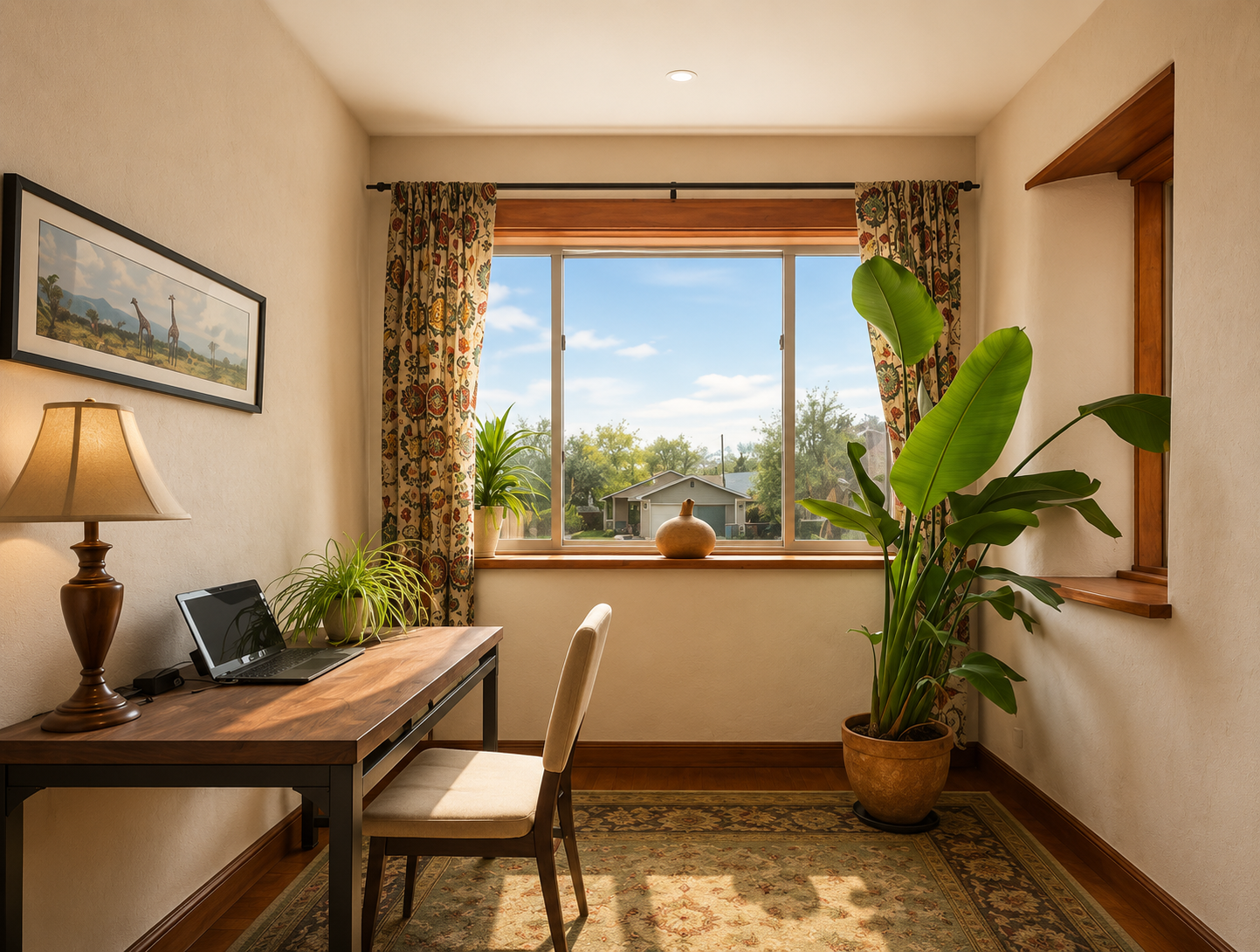
A window is the weak point in a great wall
Start with the honest truth. No matter how good a window is, it insulates far less than an R-45 straw bale wall around it. The wall is the strong part of the envelope. Every window is, by comparison, a soft spot.
That is not an argument against windows. A home needs light, views, and connection to the outside, and those things are part of what makes a house worth living in. It is an argument for being deliberate. In a home with a truly excellent wall, the windows become the place where heat is most likely to escape, so where they go, how big they are, and which direction they face all matter enormously. You are not just decorating a wall with glass. You are deciding where the envelope gives a little, and you want those decisions made on purpose.
Orientation is everything
Here is where passive solar design turns windows from a weakness into an asset. The single most powerful move is facing the right glass south.
Idaho gives you more than two hundred sunny days a year, and in winter the sun tracks low across the southern sky. A window facing south catches that low winter sun and lets it pour into the home, where the thick mass of the walls and floors soaks up the warmth and holds it. The sun does the heating. The mass stores it. This is the heart of how a home like our Squaw Butte project ran through January, February, and March of 2023 with zero mechanical heating. South-facing glass was collecting free heat every sunny day, and the building held onto it.
The other orientations call for restraint. Windows facing north lose heat and gain little, so they are used thoughtfully and kept modest. East and west glass brings low, hard sun that is difficult to control and can overheat a space, so it is placed with care. The design concentrates the glass where it does the most good and eases off where it costs you. That is orientation working as a heating strategy, not just a floor plan.
Overhangs make it work in summer
The natural worry is obvious. If south glass floods the home with sun in winter, does it not cook the house in summer? This is where the design closes the loop, and the answer is beautifully simple. The sun is not in the same place in summer as in winter.
In summer the sun rides high overhead. In winter it stays low. A properly sized overhang above a south-facing window is calculated to use that difference. It shades the glass from the high summer sun, keeping the space cool, while letting the low winter sun slip in underneath to warm the home. The same window rejects heat in July and welcomes it in January, with no moving parts, no adjustment, nothing to operate. Just geometry doing exactly what it was designed to do, season after season.
The glass itself matters too
Orientation and overhangs are the strategy, and the glazing itself is the execution. Modern high-performance windows are engineered assemblies, with multiple panes, insulating gas fills, and coatings tuned to how the window will be used. The right glazing spec for a south-facing collecting window is not necessarily the same as for a north-facing window whose only job is to hold heat in. Choosing well means matching the glass to the role each window plays in the overall design.
The point is that the window is a considered choice, part of an integrated system, not a catalog item picked for looks alone. In a home this well built, cheap or poorly chosen glass would be the leak that drains the performance out of everything else.
Designed as one system
All of this only comes together when the windows are designed alongside the home rather than selected at the end. Orientation depends on how the house sits on the land. Overhang sizing depends on the latitude, the sun angles, and the exact window below it. Glazing choice depends on the direction each window faces and the job it is doing. These are not independent decisions. They are one connected design problem, and solving it well is what separates a home that merely has nice windows from a home where the windows are quietly heating the place for free.
That integration is exactly what a design-build approach is built to deliver. When the same team places the home, sizes the overhangs, and specifies the glass, every window ends up in the right spot, at the right size, with the right glass and the right shade above it. The result is a home where the walls hold the heat and the windows help make it, and where the sun becomes one of the most reliable parts of your heating system. In the Boise Valley, with all that sunshine, that is a gift worth designing for.
